Your story has
one job:
Make them feel.
Great stories aren't built on structure. They're built on emotion. I help writers, filmmakers, and brands engineer the one thing audiences remember — a feeling that stays long after the credits roll.
Most stories are technically correct.
Almost none of them land.
Your script hits the beats. Your pitch deck has a clear narrative arc. Your commercial has a beginning, middle, and end. So why does it feel like something is missing? Why does it leave audiences unmoved?
The conventional wisdom says the answer is better structure. More precise genre mechanics. Tighter pacing. But screenwriting teachers have been selling structure for decades — and most scripts still die on the page.
The reason is simple: structure tells you where things happen. It says nothing about how to make those things felt.
A story can have perfect three-act structure, hit every beat on cue, execute all the genre conventions — and still produce exactly one emotional response in the reader: boredom. The missing variable is always the same. It's always emotion.
Hollywood is not in the entertainment business. It is in the emotion-delivery business.
There is only one rule in storytelling.
Be interesting.
Every technique I teach, every note I give, every word on every page of my books exists to serve a single purpose: to help you engineer specific, measurable emotional experiences in the people who read or watch your work.
Boredom
Where most stories live. Technically adequate. Emotionally absent. The reader is politely waiting for something to feel — and nothing comes.
Interest
The minimum requirement for professional work. The reader is engaged, following along, curious about what happens next. Competent. Forgettable.
Wow.
Where every page, every scene, every line is designed to produce something visceral. The reader leans forward. They feel something. They remember it.
"Think of yourself as a painter and emotions as the colors on your palette. If you keep emotion at the forefront of your scenes, your words will disappear and readers will lose themselves in the story."
— Karl Iglesias, Writing for Emotional ImpactRequired reading for writers who mean it.
Used in university programs worldwide. Praised by producers, directors, and working writers. Built to live on your desk, not your shelf.
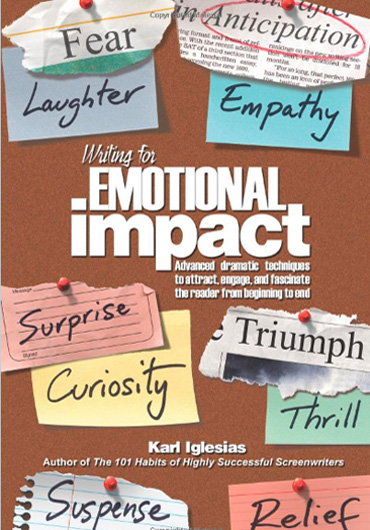
Writing for Emotional Impact
WingSpan Press · 2005 · Based on UCLA Extension Classes
The most comprehensive and practical guide to what actually makes a script work on the reader. Not structure. Not format. Not marketability. The emotional experience it produces, page by page, scene by scene, line by line.
This is the book that changes how writers read scripts — and, by extension, how they write them. Built on years of teaching at UCLA Extension, it translates the insights of a working development executive into a systematic, learnable methodology.
"Like Hank Aaron, you have set the new standard in your field. Aristotle, McKee, and now Iglesias."Learn More →

The 101 Habits of Highly Successful Screenwriters
10th Anniversary Edition · With Terry Rossio, Tony Gilroy, Aline Brosh McKenna & More
What do the writers of Pirates of the Caribbean, the Bourne franchise, Groundhog Day, and Wanted have in common? This book answers that question — not theoretically, but in their own words.
Based on extended interviews with twenty-one of Hollywood's most successful working screenwriters, it distills the habits of thought, discipline, and daily practice that separate professionals from aspiring ones. An essential complement to any craft study.
"An indispensable resource for screenwriters at every level. Not a theory book — a reality book."Learn More →
Wherever there's a story,
there's a reader to move.
My methodology applies wherever emotional engagement is the goal — from the screenplay to the boardroom presentation. The principles are universal. The application is precise.
Writers & Screenwriters
You've mastered the craft mechanics. Now master the thing that actually determines whether your script gets a Recommend: whether it makes the reader feel something.
- Feature screenplays and pilots
- Independent and studio projects
- Script doctoring and rewrites
- Concept development
- Writers Room coaching
Directors & Filmmakers
The story lives or dies in the script. A director's greatest creative leverage is ensuring that the emotional architecture of the story is intact before the first day of production.
- Pre-production script analysis
- Theme and emotional arc development
- Scene-by-scene emotional mapping
- Character and relationship depth
- Dialogue punch-up
Brands & Marketing Leaders
The same emotional engineering that makes a great film makes a great brand story. Fortune 500 companies have hired me to bring the same principles to campaigns, pitches, and presentations.
- Brand narrative development
- Campaign and commercial scripts
- Executive presentations and pitches
- Content strategy for emotional impact
- Corporate storytelling workshops
Four ways I can elevate your story.
Script Consultation & Coverage
Comprehensive page-one analysis of your screenplay, pilot, or treatment. I don't just tell you what isn't working — I show you exactly where the emotional life of your story disappears, and I give you specific, actionable tools to restore it. This is professional-grade coverage that diagnoses what readers feel (and don't feel) on every significant page.
Feature · Pilot · Short · TreatmentOne-on-One Writer Coaching
Sustained, relationship-based engagement over the arc of a project or career. We go beyond the notes on a single draft to address the deeper patterns in your writing — the habits of thought and craft that are limiting what your stories can do emotionally. Sessions are targeted, honest, and designed to produce real transformation in the work.
Ongoing · Project-Based · Career DevelopmentSeminars & Masterclasses
Half-day, full-day, and multi-session workshops built around the core principles of my methodology. I've delivered these for writing conferences, film schools, production companies, and Fortune 500 teams. Whether your group needs a foundational introduction to emotional storytelling or an advanced workshop on specific craft elements, sessions are customized for your context.
In-Person · Virtual · Corporate · AcademicStory Development & Concept Work
Collaborative development at the earliest stages of a project — from premise through outline and treatment. This is where the emotional architecture of a story is built or broken. I help you identify the theme that will give your story its spine, construct characters whose emotional lives are active and specific, and engineer a concept that makes readers feel something before page one.
Concept · Outline · Treatment · Pitch Deck
Your story deserves
to make them feel something.
Let's find the emotional core of your work — and build everything else from there. Whether you have a finished script or a half-formed idea, the conversation starts the same way: with what you want your audience to feel.
Availability is limited. Reach out early to discuss your project and current turnaround.